

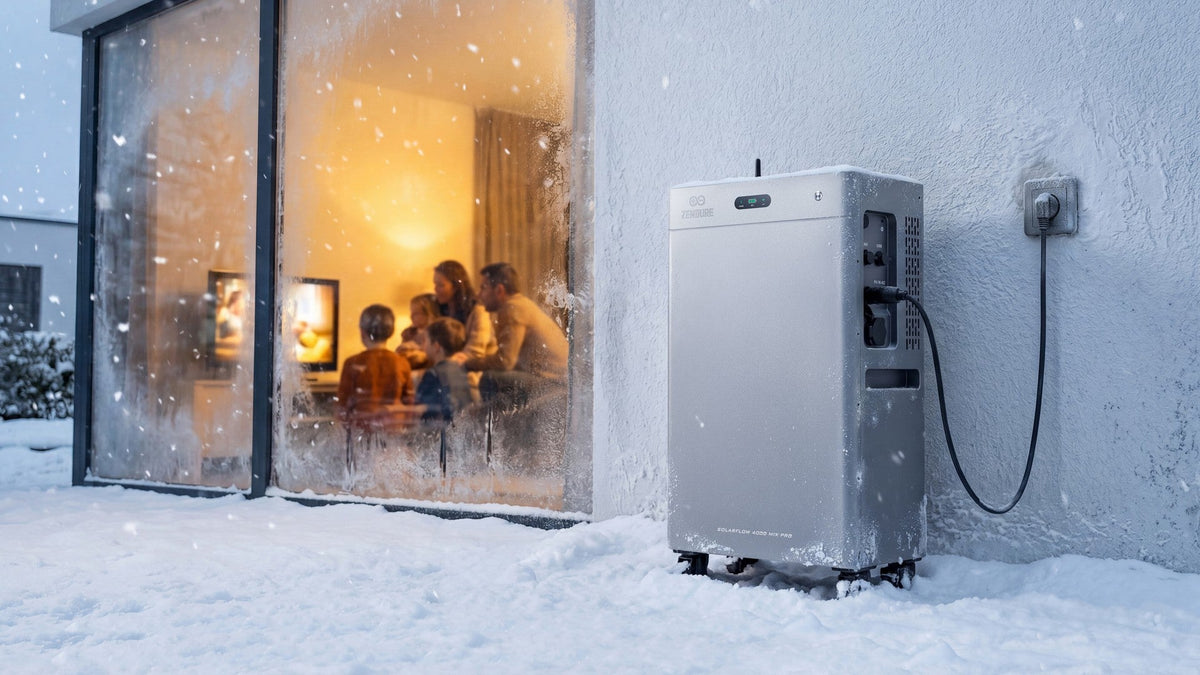
How does a home battery work in winter?
In winter, a home battery works the same way as in summer: it stores power and later delivers it back to your home. Only the source changes, because your solar panels generate far less during the winter months. What a home battery delivers in winter therefore mainly depends on your energy contract and the way you charge it.
How much solar power does a home battery store in winter?
In winter, a home battery stores little solar power, because there's hardly any surplus to save. During the winter months, solar panels together generate on average about 10 percent of their annual yield, and December is the weakest month at roughly 2 percent. Short days, a low sun and plenty of cloud cover push down generation.
At the same time, your consumption is higher in winter, because you're indoors more often and the lights are on longer. What your panels generate during the day you usually use up directly yourself. With solar power alone, home batteries therefore rarely fill up in these months.
What's the point of a home battery in winter?
A home battery is mainly useful in winter if you can shift power from cheap to expensive moments. The battery then works less as storage for solar surplus and more as a buffer for your evening consumption. Whether a home battery makes sense in winter mainly depends on your energy contract:
- Dynamic contract: even in winter the battery has work to do every day, with or without sun.
- Fixed contract with solar panels: the battery relies on the small solar surplus and has little to do on grey days.
- Fixed contract without solar panels: in winter the battery has almost nothing to shift.
Which situation fits you also determines how to charge the battery smartly in winter.
How do you charge a home battery in winter?
In winter, you charge a home battery from two sources: the solar power your panels have left over during the day and power from the grid. Which source the battery uses and when is something you set via the app or the manufacturer's energy management system.
With Zendure and Anker SOLIX, an energy meter measures your consumption – for example a P1 meter that reads out your smart meter – so the battery charges and discharges automatically.
Charging a home battery with winter sun
Charging a home battery with winter sun works on clear days, usually around midday. The surplus is small, but still covers part of your evening consumption. So don't fully charge the battery overnight with grid power ahead of a sunny day, otherwise there's no room left for your own generation.
Some energy management systems factor in the weather forecast for this. They then deliberately leave room free when sun is expected.
Charging your home battery with cheap grid power
Charging a home battery with cheap grid power only pays off if your electricity price varies by the hour, as with a dynamic energy contract. The hourly prices from 2025 show that electricity was on average cheapest between 12:00 and 15:00 and most expensive between 19:00 and 21:00, with the biggest differences in winter. The battery then charges during the cheap hours and discharges during the evening peak.
With a fixed contract with a single rate, charging from the grid earns nothing, because the price is then the same every hour. If you mainly want to use the battery with grid power, take a look at a home battery without solar panels.
What does cold do to a home battery?
Cold causes a home battery to charge more slowly and temporarily have less available capacity. Lithium iron phosphate cells (LFP), which are in most home batteries, don't charge below 0 °C, while discharging does continue. With Zendure's batteries, discharging continues down to -20 °C. The battery management system (BMS) monitors the temperature and limits the charging power as soon as it gets too cold.
To still be able to charge, the Zendure SolarFlow 2400 AC+ and 2400 Pro have a self-heating function, just like the expansion batteries AB2000L, AB2000X, AB3000L and AB3000X. That function first warms up the cells between -20 and 0 °C using grid or solar power, and that warming up itself also costs energy. In a frost-free space this barely plays a role. You can read what to arrange when the battery is placed outside in the article about placing a home battery outside.
Is a home battery profitable in winter?
A home battery is less profitable in winter than in summer, because it shifts fewer kilowatt-hours per day. From 2027, without the net metering scheme, every stored kWh of solar power in summer earns the difference between your electricity rate and the compensation you would otherwise get for feeding power back. In winter, a kWh from the grid only earns the price difference between a cheap and an expensive hour, minus the loss from charging and discharging.
With a fixed energy contract, most of the annual savings therefore come from spring and summer. So assess the returns over a full year and not per season. You can read how to calculate that yearly total for your own situation in the article about the payback time of a home battery.
A home battery for the whole year at TechPunt
You choose a home battery for the whole year based on your usage, your energy contract and where it will be placed. At TechPunt you'll find plug-in and modular systems from Zendure and Anker SOLIX, with a 2-year manufacturer's warranty. We ship them from our own warehouse in Barneveld.
Not sure which system fits your winter usage? Ask our customer service a question by phone, email or WhatsApp.


